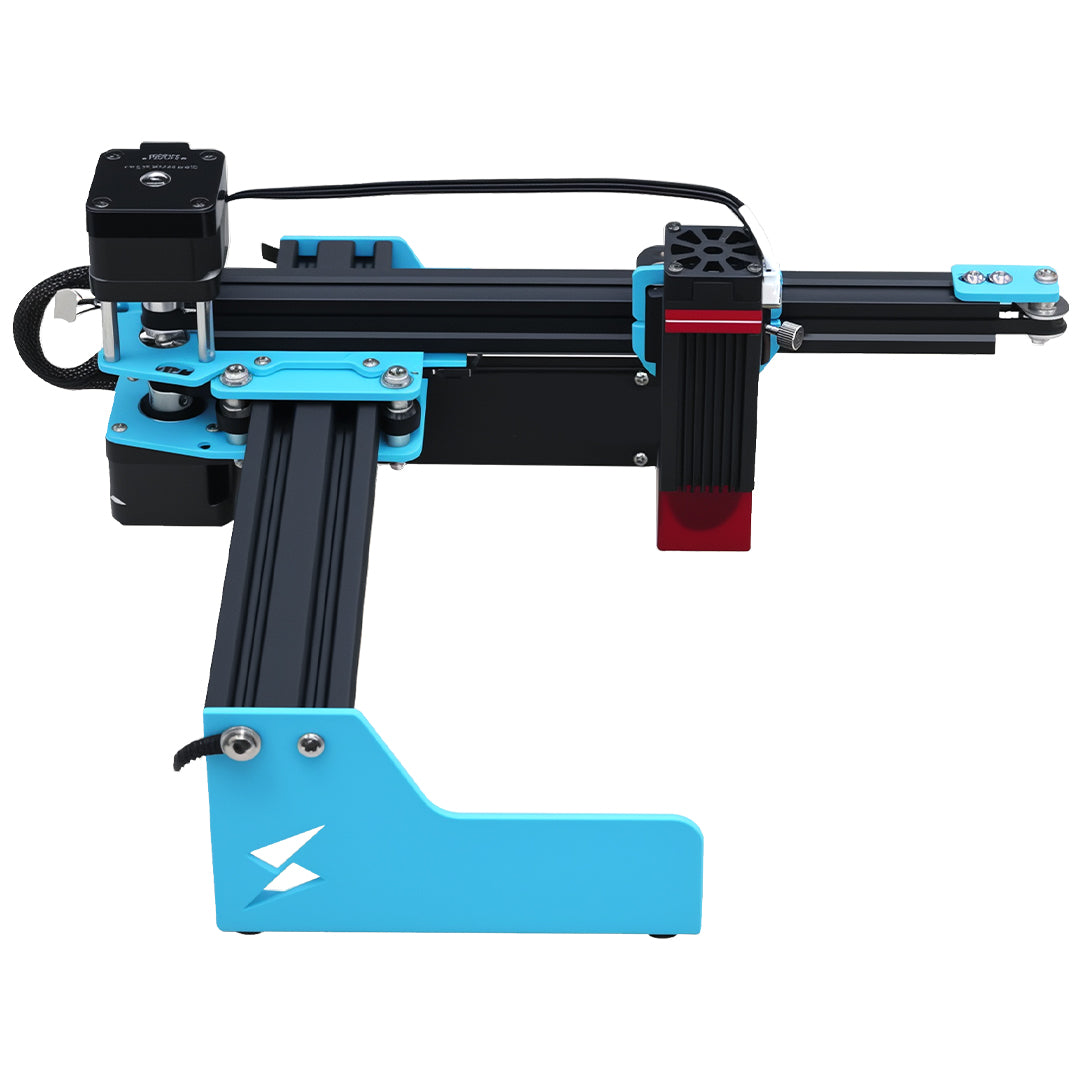


For a first small fabric project, choose scissors or a rotary cutter when they can produce the required shapes with less preparation. Consider a laser only after the exact textile and process are confirmed for the selected A1 Mini configuration and extraction setup. Owning a laser does not make it the best tool for every cut.
A July 28, 2026 maker question asks about using lasers for costume and jewelry fabrics. The useful starting point is the finished piece: its size, outline, seam needs and quantity. The discussion supplies no A1 Mini fabric qualification.
Compare the work before the cutting begins
A rotary cutter needs a suitable mat, ruler or template, careful blade handling and a safe workspace. Scissors can follow a few curved shapes without requiring a digital file. A laser adds material documentation, artwork preparation, supported workholding, extraction and continuous supervision.
The A1 Mini product page currently lists a 120 × 130 mm engraving area. Compare the whole intended pattern and any required positioning margin with the usable setup, not just the decorative feature inside it. A piece larger than the supported area is a strong reason to choose another method for the first project.
| First-project requirement | Practical comparison |
|---|---|
| Four simple rectangles | Mechanical template may finish preparation sooner |
| Broad garment panel | Compare full pattern with the compact area |
| Detailed repeated outline | Digital preparation may be useful, if qualified |
| Unknown coating or backing | Do not laser; choose an appropriate mechanical method |
| Iron-on attachment | Apply only after cutting; do not laser installed adhesive |
Work through a small example
Suppose you need four 70 × 90 mm fabric pockets. A paper template can show the cut boundary, fold line and seam allowance. On a cutting mat, measure one piece, check the intended fold, and then use the confirmed template for the remaining three.
Although that outline is numerically smaller than the published A1 Mini area, geometry alone does not justify laser use. Ask whether the exact fabric, dyes and treatments are permitted, how it must be supported, and which extraction arrangement is required. If those answers are unavailable, the mechanical route can still complete the pockets.
For an intricate motif that scissors distort, compare an accurately cut paper sample with the intended stitch line before choosing a machine. Digital precision cannot rescue the wrong seam allowance. Count the time spent preparing and checking the file alongside the time spent physically cutting.
Read the fabric's whole construction
Fiber labels can omit the information needed for laser processing. Backing, surface treatments and applied adhesive matter. The craft-plywood label explanation shows why a shop category is weaker than construction documentation; it is an analogy, not textile safety guidance.
Repeated quantities also do not grant permission to stack. The single-layer versus supported-stack decision keeps every layer's eligibility and acceptance separate. For a beginner project, a manageable mechanical workflow often avoids making layer count another unresolved variable.
Will laser cutting seal the edges of my fabric?
Do not assume it. Edge behavior depends on the complete material and supported process, and a changed edge may be undesirable for sewing or skin contact. Specify the edge your project actually needs and choose a documented method that produces it.
Is buying A1 Mini worthwhile just for four pockets?
Evaluate the project you have, not hypothetical future volume. If scissors or a rotary cutter already meet the size and finish requirements, they may be the practical purchase. Consider A1 Mini separately for a wider set of qualified projects and the workspace it requires.