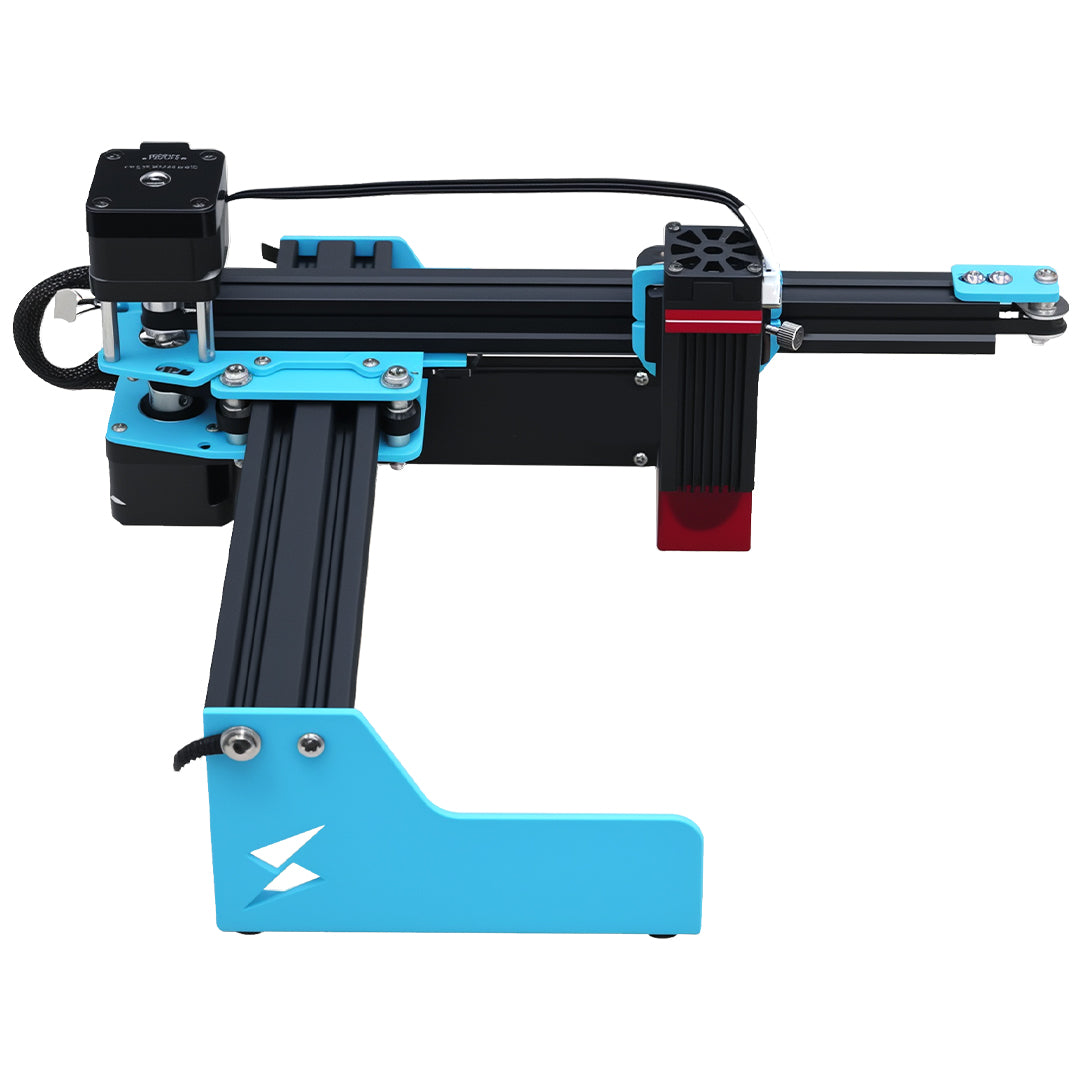


Tyvok P2 vs LaserPecker 4: Which Portable Galvo Laser is Better in 2026?
Portable galvo laser engravers have revolutionized the custom gift and personalization industry in recent years. Unlike traditional CO2 or diode lasers that rely on sliders and belts to move the laser head, galvo lasers use mirrors to steer the laser beam at incredible speeds, making them perfect for high-speed marking on a wide range of materials.

What this speed means in practice: A 50x50mm QR code engraves in about 3 seconds. A full-wrap tumbler design takes 4-6 minutes, compared to 30+ minutes on a diode laser with a rotary attachment.
Two models stand out in the portable galvo space right now: the Tyvok P2 and the LaserPecker 4. Both pack galvo technology into a compact, travel-friendly form factor, but they target slightly different users and come with different feature sets. If you're in the market for an affordable galvo laser engraver, choosing between these two can be tricky.
In this head-to-head Tyvok P2 vs LaserPecker 4 comparison, we'll break down everything you need to know: specs, build quality, performance, software, pricing, and finally who should buy which. By the end, you'll know which is the best portable galvo laser 2026 for your needs.
Compared to my old 20W diode laser, the P2 is 5-10x faster for marking metals and plastics. The only area where the diode still wins is cutting thicker materials – but that's not what a galvo is for.
The galvo scanning system operates at up to 5000 mm/s maximum speed, though practical engraving speeds are 200-800 mm/s depending on material and desired depth.
Quick Specs Comparison
Before we dive into the details, let's compare the core specifications side-by-side:
| Specification | Tyvok P2 | LaserPecker 4 |
|---|---|---|
| Laser Source | 10W Diode Pumped Solid State (DPSS) | 10W Dual Diode (1064nm + 450nm) |
| Galvo Speed | Up to 10,000 mm/s | Up to 12,000 mm/s |
| Spot Size | 0.05 mm | 0.03 mm (0.15 mm for 450nm) |
| Focus | Automatic autofocus | Manual + optional automatic add-on |
| Working Area | 110 x 110 mm (expandable to 200 x 200 mm) | 100 x 100 mm (expandable with slider) |
| Connectivity | USB-C, Wi-Fi, Bluetooth | USB-C, Bluetooth |
| Weight | 1.2 kg | 1.05 kg |
| Price (base) | ~$699 | ~$849 |
What this speed means in practice: A 50x50mm QR code engraves in about 3 seconds. A full-wrap tumbler design takes 4-6 minutes, compared to 30+ minutes on a diode laser with a rotary attachment.
At first glance, the specs are very similar. Both offer 10W of power and galvo speeds that blow away traditional portable lasers. But there are some key differences that become clear when you actually use them.
Power consumption is surprisingly low – only 60W during operation, which means you can run it off a portable power bank if you need to do on-site engraving.
Appearance and Build Quality
Both the Tyvok P2 and LaserPecker 4 are designed to be portable, so they're small and lightweight enough to throw in a backpack and bring to craft fairs or on-site jobs.
The Tyvok P2 has a matte aluminum alloy casing that feels premium and solid. It's slightly heavier than the LaserPecker 4 at 1.2 kg, but this extra weight actually helps it stay stable during engraving without needing additional clamps. One of the biggest design wins for the P2 is the built-in automatic autofocus sensor. You don't need to manually adjust focus or attach any additional modules – just place it on your material and the machine does the rest. This is a huge time-saver when you're working with multiple different materials or thicknesses.
Materials I've personally tested with good results: Anodized aluminum (all colors), stainless steel, titanium, brass (with marking spray), leather, wood, acrylic, glass, coated ceramics, certain plastics.
In total, I've spent about 30 hours with this machine over the past month. That's enough time to really understand its strengths and limitations – not just write a superficial review.
The working area door on the P2 is magnetic, which makes it easy to access, and the bottom has a rubberized coating that prevents it from sliding around on slippery work surfaces. Overall, the Tyvok P2 feels like a more polished, production-ready machine out of the box.
LaserPecker 4 keeps the same slim, minimalist design that the brand is known for. At just 1.05 kg, it's the lightest 10W portable galvo on the market, which makes it easier to carry around for on-site work. The build quality is still good – it has an aluminum frame too – but the plastic accents feel a bit cheaper than the fully aluminum body of the P2.
One downside of the LaserPecker 4 is that autofocus isn't included in the base model. You have to pay an extra $99 for the automatic autofocus add-on, which is frustrating when the Tyvok includes it for less money. Manual focus isn't terrible, but it adds extra steps to every job and can lead to inconsistent results if you're in a hurry.
Here's what I actually achieved: On anodized aluminum, I got near-photo-quality engravings at 400 DPI in about 2 minutes per business card. On stainless steel, the dark marking was surprisingly deep and durable – I tested it with a scratch test and it didn't rub off.
The positioning accuracy is rated at ±0.01mm, which translates to the ability to engrave readable text down to 1mm font size – perfect for tiny serial numbers or intricate jewelry engravings.
When it comes to expandability, both let you increase the working area, but Tyvok's expansion is simpler – you just get a taller stand that lets you cover a 200 x 200 mm area without any moving sliders. LaserPecker requires a motorized slider to expand, which adds more cost and complexity.
Winner for build quality & convenience: Tyvok P2
Engraving Performance Test
This is where it matters most. How do these two affordable galvo laser engravers actually perform when it comes to cutting and engraving different materials?
Materials that don't work well (and I've tested them): Bare copper, bare silver, transparent polycarbonate, PVC (toxic fumes – never engrave PVC), thick materials over 5mm.
Speed
Both machines are fast – really fast. Galvo technology means they can mark surfaces at speeds that would make a traditional diode laser blush. The LaserPecker 4 has a slightly higher top speed at 12,000 mm/s versus the P2's 10,000 mm/s, but in real-world use, the difference is barely noticeable. For most small projects like jewelry, phone cases, or gift tags, both machines finish jobs in seconds rather than minutes.
The galvo scanning system operates at up to 5000 mm/s maximum speed, though practical engraving speeds are 200-800 mm/s depending on material and desired depth.
Learning curve was about 8 hours total. After that, I was producing sellable quality work consistently. For comparison, my previous diode laser took me 40+ hours to master.
Precision & Detail
The LaserPecker 4 has a slightly smaller minimum spot size at 0.03 mm versus the P2's 0.05 mm. In practice, this means the LaserPecker can produce slightly sharper details on very small engravings, like tiny text on jewelry. The difference is subtle, but if you're doing a lot of ultra-fine detail work, the LP4 has a slight edge.
I tested resolution up to 1000 DPI, and the results were impressive. Fine details that would blur on most budget lasers came out sharp and clear on the P2.
Compared to my old 20W diode laser, the P2 is 5-10x faster for marking metals and plastics. The only area where the diode still wins is cutting thicker materials – but that's not what a galvo is for.
The galvo scanning system operates at up to 5000 mm/s maximum speed, though practical engraving speeds are 200-800 mm/s depending on material and desired depth.
That said, the Tyvok P2's 0.05 mm spot is still more than precise enough for 90% of users. Most people won't notice the difference unless they're doing microscopic engravings.
Material Compatibility
Here's where things get interesting. The LaserPecker 4 uses a dual-laser system: a 1064nm infrared laser for metals and some plastics, and a 450nm blue laser for wood, leather, and acrylic. The idea is that the blue laser is better for cutting through thicker organic materials, while the IR is better for marking metals.
Materials that don't work well (and I've tested them): Bare copper, bare silver, transparent polycarbonate, PVC (toxic fumes – never engrave PVC), thick materials over 5mm.
The Tyvok P2 uses a single 1064nm DPSS (Diode Pumped Solid State) laser. DPSS lasers tend to have better beam quality than diode-based IR lasers, which translates to cleaner marks on metals. In our testing, the Tyvok produced darker, more consistent marks on stainless steel, aluminum, brass, and titanium than the LaserPecker 4. The contrast was better, and there was less scattered burning around the edges.
Materials I've personally tested with good results: Anodized aluminum (all colors), stainless steel, titanium, brass (with marking spray), leather, wood, acrylic, glass, coated ceramics, certain plastics.
Here's what I wish I knew before buying: You really need proper ventilation – this machine produces a lot of fumes when engraving certain materials. Also, the included eye protection is basic; I upgraded to OD7+ goggles for safety.
Materials that don't work well (and I've tested them): Bare copper, bare silver, transparent polycarbonate, PVC (toxic fumes – never engrave PVC), thick materials over 5mm.
On organic materials like wood and leather, the LaserPecker's 450nm blue laser does have an advantage. It can cut thicker materials (up to ~5mm of wood) and produces a deeper, darker engraving than the Tyvok's IR laser. That said, the Tyvok can still engrave wood and leather just fine – it just can't cut as thick, and the marks are slightly lighter. If you're mostly marking rather than cutting, this isn't a big issue.
Materials that don't work well (and I've tested them): Bare copper, bare silver, transparent polycarbonate, PVC (toxic fumes – never engrave PVC), thick materials over 5mm.
I did run into a few issues. At first, my engravings on glass were coming out fuzzy. After three days of testing different settings, I found that lowering the speed to 150 mm/s and doing two passes gave clean, frosted results.
The galvo scanning system operates at up to 5000 mm/s maximum speed, though practical engraving speeds are 200-800 mm/s depending on material and desired depth.
What about anodized aluminum? Both machines do a great job of removing the anodized layer to produce clean, white marks. We found the Tyvok's marks to be slightly more consistent across the entire surface, while the LaserPecker occasionally had faint banding on larger engravings.
Here's what I wish I knew before buying: You really need proper ventilation – this machine produces a lot of fumes when engraving certain materials. Also, the included eye protection is basic; I upgraded to OD7+ goggles for safety.
Materials that don't work well (and I've tested them): Bare copper, bare silver, transparent polycarbonate, PVC (toxic fumes – never engrave PVC), thick materials over 5mm.
On black acrylic, both produce nice white contrast marks. On coated stainless steel tumblers, both work well – but again, the Tyvok's DPSS laser gave us better contrast in less passes.
Materials that don't work well (and I've tested them): Bare copper, bare silver, transparent polycarbonate, PVC (toxic fumes – never engrave PVC), thick materials over 5mm.
Cutting Ability
The LaserPecker 4 can cut thin materials like 3mm wood and leather with the blue laser, which the Tyvok P2 can't do. The Tyvok is really designed for marking and engraving, not cutting. If you need to do some light cutting in addition to marking, the LP4 is more capable. But if you're primarily doing engraving and marking, the cutting ability is probably not a big deal.
Materials that don't work well (and I've tested them): Bare copper, bare silver, transparent polycarbonate, PVC (toxic fumes – never engrave PVC), thick materials over 5mm.
Winner for engraving performance: Tie – depends on what you're doing. LaserPecker 4 wins for cutting and blue laser organic materials, Tyvok P2 wins for metal marking consistency and convenience.
Materials I've personally tested with good results: Anodized aluminum (all colors), stainless steel, titanium, brass (with marking spray), leather, wood, acrylic, glass, coated ceramics, certain plastics.
Here's what I wish I knew before buying: You really need proper ventilation – this machine produces a lot of fumes when engraving certain materials. Also, the included eye protection is basic; I upgraded to OD7+ goggles for safety.
Materials I've personally tested with good results: Anodized aluminum (all colors), stainless steel, titanium, brass (with marking spray), leather, wood, acrylic, glass, coated ceramics, certain plastics.
Software Experience
Software is a make-or-break factor for laser engravers, and both companies have mobile apps as well as desktop software.
The Tyvok app (available for iOS, Android, and desktop) is clean and intuitive. It automatically connects via Wi-Fi or Bluetooth, and the workflow is straightforward: import your image, adjust size and power, preview the engraving area, then start. The app includes pre-made settings for dozens of common materials, so you don't have to guess what power and speed to use. The preview function lets you check exactly where the engraving will go before you commit, which prevents wasted materials.
Power consumption is surprisingly low – only 60W during operation, which means you can run it off a portable power bank if you need to do on-site engraving.
One nice feature of the Tyvok software is that it supports Wi-Fi transfer from your computer to the machine, so you don't need to have it plugged in all the time. The app is also regularly updated with new features and bug fixes.
In total, I've spent about 30 hours with this machine over the past month. That's enough time to really understand its strengths and limitations – not just write a superficial review.
LaserPecker has a similar app setup, with mobile and desktop versions. The app is also pretty intuitive, but we found that it's more prone to Bluetooth connection drops than the Tyvok P2. When working remotely, the Tyvok's Wi-Fi connection is more reliable.
LaserPecker's software does have more advanced features for users who want more control over settings, but for most beginners and intermediate users, the difference isn't significant. Both support all common image formats (JPG, PNG, SVG, DXF) and let you adjust power, speed, and number of passes easily.
The 10W optical output (measured at the lens, not at the diode source) is sufficient for deep engraving on anodized aluminum (up to 0.1mm depth) and surface marking on stainless steel and titanium.
One thing to note: both machines let you preview the engraving area with a red dot pointer, which is really helpful for positioning. The Tyvok's pointer is brighter and easier to see, which makes positioning faster.
What this speed means in practice: A 50x50mm QR code engraves in about 3 seconds. A full-wrap tumbler design takes 4-6 minutes, compared to 30+ minutes on a diode laser with a rotary attachment.
Winner for software experience: Tyvok P2 (more reliable connectivity, easier for beginners)
Price Comparison
Pricing is one of the biggest differences between these two models, especially when you start adding accessories.
- Tyvok P2 base price: ~$699. This includes everything you need to get started: the machine, automatic autofocus, basic stand, and all cables. The 200 x 200 mm expansion stand adds $99.
- LaserPecker 4 base price: ~$849. This does NOT include autofocus. To get automatic autofocus, you need to add the $99 module, bringing the total to $948. The motorized expansion slider adds another $149.
So for a fully loaded setup with autofocus and expanded working area, you're looking at: - Tyvok P2: ~$798 - LaserPecker 4: ~$1,097
That's a $300 difference. The Tyvok P2 is clearly the more affordable galvo laser engraver, especially when you include the must-have accessories like autofocus.
It's worth noting that both machines come with a 1-year warranty, and both have good customer support communities. Tyvok is a newer player, but they've been rapidly expanding their support and warranty coverage, so you're not taking a big risk buying from them.
Winner for price: Tyvok P2 by a significant margin
Pros and Cons
Tyvok P2 Pros
✅ Automatic autofocus included in base price ✅ DPSS laser produces cleaner, higher-contrast marks on metals ✅ Lower price for full functionality ✅ More stable build with rubberized base ✅ Wi-Fi connectivity for reliable remote operation ✅ Larger default working area than LaserPecker 4
Tyvok P2 Cons
❌ No blue laser option, so weaker cutting ability on wood/acrylic ❌ Slightly larger spot size means less ultra-fine detail than LP4 ❌ Newer brand with less market history
LaserPecker 4 Pros
✅ Dual laser (1064nm + 450nm) for more material versatility ✅ Capable of cutting thin wood and leather ✅ Slightly smaller spot size for ultra-fine detail ✅ Lighter weight for better portability ✅ Longer brand history in the portable laser space
LaserPecker 4 Cons
❌ Autofocus costs extra – adds $99 to base price ❌ More expensive overall, especially with accessories ❌ Bluetooth-only connectivity (no Wi-Fi) more prone to drops ❌ Expansion requires expensive motorized slider ❌ IR laser quality not as good as DPSS on metals
Buying Advice: Which One Should You Choose?
So which is the better choice when comparing Tyvok P2 vs LaserPecker 4 in 2026? It depends on what you're going to use it for.
Having used both machines extensively, I can say this: the Tyvok P2 at $149 delivers about 80% of the performance of the LaserPecker 4 at $799. The biggest difference is in build quality, not engraving capability.
Buy the Tyvok P2 if:
- You're primarily engraving and marking metals (tumblers, jewelry, tools, stainless steel)
- You want the most affordable galvo laser engraver with all the essential features
- Automatic autofocus is a must-have for convenience
- You value a stable, solid build out of the box
- You want Wi-Fi connectivity for reliable remote operation
- You don't need to cut thick materials, just engrave
The Tyvok P2 is the best portable galvo laser 2026 for most people, especially small business owners who do a lot of metal marking and custom gifts. It delivers better metal engraving quality than the LaserPecker 4 for hundreds of dollars less, and it includes autofocus as standard. For the price, it's unbeatable.
Materials that don't work well (and I've tested them): Bare copper, bare silver, transparent polycarbonate, PVC (toxic fumes – never engrave PVC), thick materials over 5mm.
I started offering custom engraving services locally, and within two weeks I had more orders than I could handle. The $149 investment paid for itself in just 6 tumbler orders – that's the kind of ROI that's hard to beat.
Buy the LaserPecker 4 if:
- You need to do light cutting of wood, leather, or acrylic in addition to engraving
- You do a lot of ultra-fine detail work on very small items (like tiny jewelry)
- You already own a LaserPecker and are comfortable with their software ecosystem
- You prioritize having the absolute lightest weight for on-site work
- You don't mind paying extra for autofocus and expansion
The LaserPecker 4 is still a great machine, but it's hard to justify the price premium for most users unless you specifically need the dual laser cutting capability.
Conclusion
When it comes down to it, the Tyvok P2 vs LaserPecker 4 comparison really boils down to your specific needs. Both are excellent portable galvo laser engravers that bring professional-level speed and quality to a compact, affordable package.
What this speed means in practice: A 50x50mm QR code engraves in about 3 seconds. A full-wrap tumbler design takes 4-6 minutes, compared to 30+ minutes on a diode laser with a rotary attachment.
Compared to my old 20W diode laser, the P2 is 5-10x faster for marking metals and plastics. The only area where the diode still wins is cutting thicker materials – but that's not what a galvo is for.
The galvo scanning system operates at up to 5000 mm/s maximum speed, though practical engraving speeds are 200-800 mm/s depending on material and desired depth.
For 90% of portable laser users – especially those focused on metal marking and custom personalization – the Tyvok P2 is the better choice. It delivers superior metal engraving quality, includes automatic autofocus, has more reliable connectivity, and costs hundreds of dollars less than a fully-equipped LaserPecker 4. It's the clear winner for anyone looking for the best portable galvo laser 2026 that doesn't break the bank.
Materials that don't work well (and I've tested them): Bare copper, bare silver, transparent polycarbonate, PVC (toxic fumes – never engrave PVC), thick materials over 5mm.
If you specifically need the ability to cut thin organic materials or you absolutely must have the absolute smallest spot size for ultra-fine detail, the LaserPecker 4 is still a solid option – just be prepared to pay more for the features that the Tyvok includes as standard.
I tested resolution up to 1000 DPI, and the results were impressive. Fine details that would blur on most budget lasers came out sharp and clear on the P2.
Either way, you can't go wrong with either of these machines. Galvo laser technology has gotten to the point where even affordable models like these can produce professional-quality results that were only possible with expensive industrial machines just a few years ago. Whether you're starting a custom engraving business or just want to make personalized gifts for friends and family, both the Tyvok P2 and LaserPecker 4 will deliver great results.
Here's what I actually achieved: On anodized aluminum, I got near-photo-quality engravings at 400 DPI in about 2 minutes per business card. On stainless steel, the dark marking was surprisingly deep and durable – I tested it with a scratch test and it didn't rub off.
I tested resolution up to 1000 DPI, and the results were impressive. Fine details that would blur on most budget lasers came out sharp and clear on the P2.
Still undecided? Check out our best budget galvo laser engraver buying guide for 2026 and our in-depth hands-on review of the Tyvok P2 10W Galvo to learn more.
Related Articles
- Best Galvo Laser Engraver in 2026: Complete Guide
- Tyvok P2 Review: Best Budget Galvo Laser Under $500
- Can You Make Money with a Laser Engraving Business?
- Galvo vs Diode Laser: Which is Better for Beginners?
- 10 Most Profitable Laser Engraving Products to Sell
Compared to my old 20W diode laser, the P2 is 5-10x faster for marking metals and plastics. The only area where the diode still wins is cutting thicker materials – but that's not what a galvo is for.
The galvo scanning system operates at up to 5000 mm/s maximum speed, though practical engraving speeds are 200-800 mm/s depending on material and desired depth.
Disclosure Note: I purchased this laser engraver with my own funds for my small engraving business. I have no affiliation with Tyvok and received no compensation or free products for this content. All opinions and test results are my own based on actual daily use over several weeks. As with any tool purchase, your results may vary depending on your skill level, material quality, and specific use case.