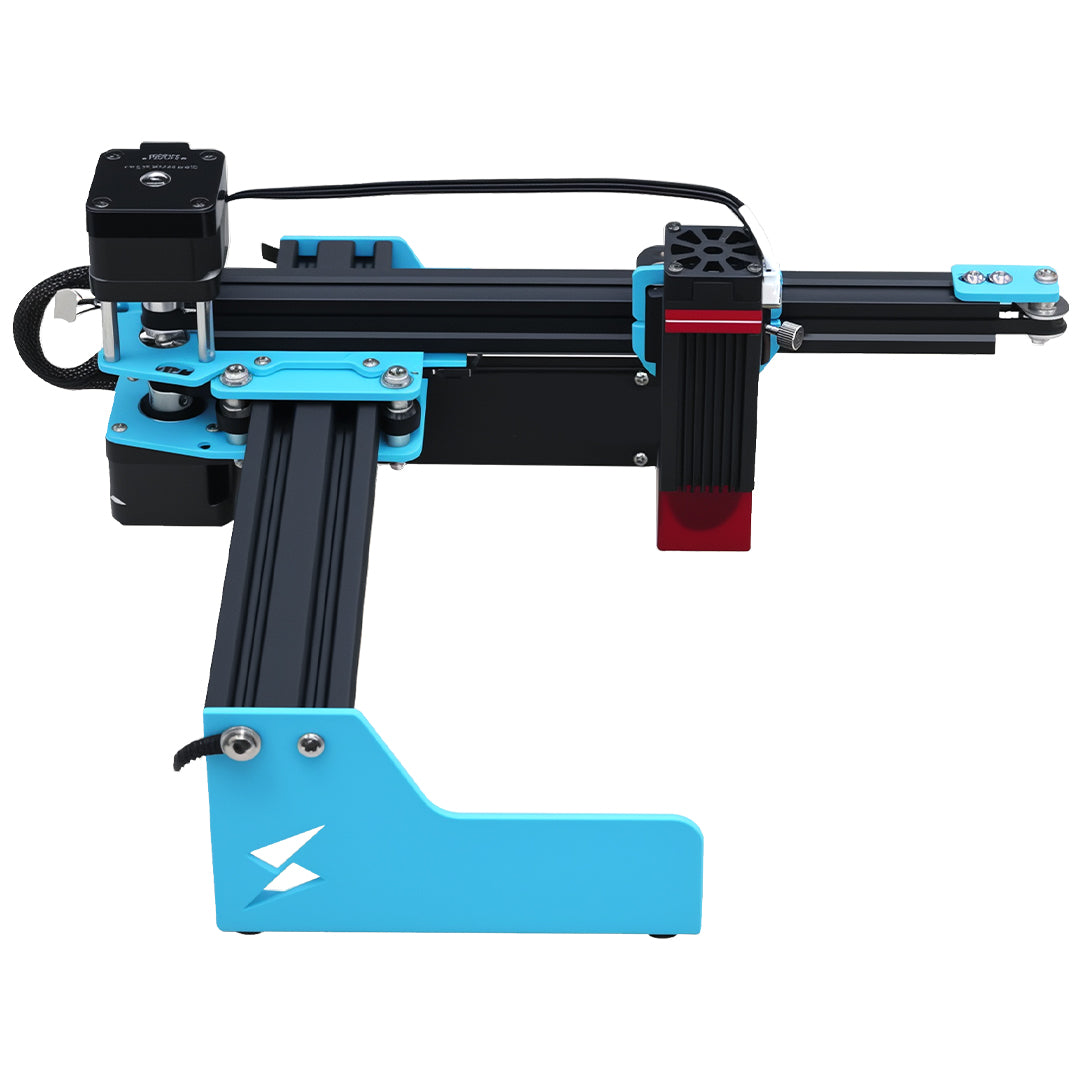


An intentionally flat two-color logo usually needs a deliberate solid-mark conversion before it needs photographic dithering. Decide which shapes should engrave and which should remain unmarked. Do not assume two different colors will automatically become two distinct shades on wood.

LaserPecker's dithering explanation distinguishes tonal images from simple black-and-white artwork. That is useful image-preparation context, not a promise that an A1 Mini uses the same algorithms or software buttons.
Decide what the two colors mean
If both colored shapes are essential, converting them to the same dark value may merge their shared edge. A threshold control cannot recover a boundary that the chosen conversion removes. Ask for an approved single-color logo, or revise the artwork with permission to preserve the important separation.
For a dark symbol on a light background, first inspect a plain black-and-white preview at the intended physical size. Look at letter counters, narrow gaps and the boundary around the symbol. Photograph-like dots can introduce texture that the original logo never contained.
| Logo input | Preparation question | Useful proof |
|---|---|---|
| Two solid colors touching | Must their boundary remain visible? | Approved monochrome variation |
| Black symbol on white | Are small openings still clear? | Full-size binary preview |
| Soft shadow or gradient | Is tonal information actually needed? | Separate tonal comparison sample |
| Already dotted artwork | Has dithering already occurred? | Inspect original pixels before another conversion |
Test one mark before committing gift blanks
Use a known compatible spare blank with the same surface as the intended gift. Compare the small openings and solid areas with the approved preview. Do not judge only by the darkest patch; a dark logo with unreadable letters has not passed the test.
For a genuine photograph, the A1 photo-dither test card addresses a different input. If letters disappear at the outer edge of an export, investigate artwork bounds instead of adding more dots. Keep an editable master so the approved monochrome version can be revised without painting over a flattened image.
The A1 Mini is suited to a compact beginner engraving workflow within its 120 × 130 mm area. Confirm the actual software, installed configuration and material suitability before output. Image conversion does not create full-color engraving, make unknown coatings safe, or establish universal settings. Reject unidentified plastic, PVC and vinyl; maintain extraction and prescribed laser protection and remain present during the sample.
Will threshold preserve red and blue as different engraving colors?
No. Threshold assigns pixels to two output states. Red and blue can end up in the same state depending on their converted values. Approve a monochrome interpretation rather than promising the original colors on the finished blank.
Must I avoid dithering whenever a file is called a logo?
No. Some logos include shading that genuinely matters. Judge the actual artwork and the intended small mark. Compare a tonal sample only when that detail is required, instead of treating a file's label as a processing rule.